
By Bay City News Service | Source |
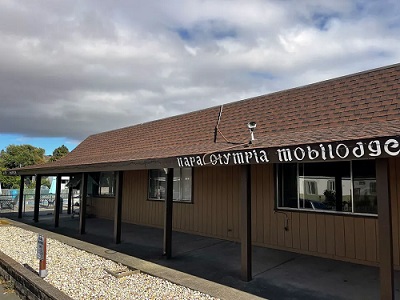
The Napa Olympia Mobilodge at 244 American Canyon Road in American Canyon was built in 1960 with 201 single and double-wide mobile homes. In May 2026, Napa OML MHP 101 LLC took majority ownership of the mobile home park, bringing in Harmony Communities to manage the property. Residents at the property own their mobile homes and pay for gas, electricity and water, but rent the space surrounding their home, which includes amenities like a pool and community room. With the change came a proposed rent hike of around $280 a month for each homeowner and rules including a limit of 10 potted plants per resident. (Griffin Jones/Bay City News)
Two hundred households in an American Canyon mobile home park face whopping rent increases in September — in many cases close to $300 a month, a boost of more than 40% for most.
As a result, some residents say they may have no choice but to move.
Built in the 1960s, Napa Olympia Mobilodge is a 201-unit mobile park on American Canyon Road near the Vallejo border. In a lot of ways, it’s a time capsule: kids bike down the middle of streets with no traffic signs, and ’70s Fleetwood double-wides line up in neat, colorful rows. It’s also highly diverse, with people speaking Tagalog, Spanish, Vietnamese and Arabic, among other languages.
Mobile parks are an accessible way for low-income people to buy a residence, although they still pay typically modest rent and utilities to park owners each month.
But in May, residents were informed of the planned big rent increase by Stockton-based Napa OML MHP 101 LLC, which has co-owned the property since 2005 and recently became the majority owner. The company, which is run by trustees of the Ubaldi Living Trust, had brought on a management company, Stockton-based property manager Harmony Communities, to help carry out a major planned refurbishing of the mobile park, which it cites as the reason for the rent increases.
Many residents agree the mobile park needs repairs and improvements, but they say the planned increases are too large, especially coming all at once. And in response to the flurry of notices from new managers, which included both the rent hikes and a laundry list of new rules, residents have taken action.
More than 130 households have signed a petition against the increase, joining mobile park residents around the state who have faced off with Harmony over eviction notices, rent increases and, in at least one case, the pending closure of a senior mobile park near Santa Cruz.
Claudia Sanches, 24, has taken a prominent role in representing fellow residents.
“Most people are retired seniors,” said Sanches, the youngest homeowner at the park. On seeing neighbors’ distress at the rent hike in May, she went all in, helping with a multi-lingual WhatsApp group and keeping a spreadsheet of signatures.
Sanches sent the signed petition to American Canyon’s Community Development Department in late June. The city has rules in place to protect mobile park residents, like a rent cap that calls for an extensive mediation process for any increase higher than the consumer price index, or the rate of inflation.
“The city is working to convene a mediation panel,” said Brent Cooper, the city’s director of Community Development. Cooper immediately called Sanches when he received the petition.
“If mediation does not result in an agreement, the next step may be arbitration, where a final and binding decision would be made,” said Cooper.
Cooper’s staff is also producing a website dedicated just to Napa Olympia “to provide updates on the status of the review and access to public documents,” he said.
Sanches pointed to a stack of notices from Harmony and from Ubaldi’s LLC on her dining room table.
“All of this was sent in English,” she said. “And I would say 70% of people here are non-English speakers.”
Maria Ferreyra is one of them. Ferreyra, who speaks only Spanish, lives with her son in a single-wide, the last house on her street. A newer resident, her rent is already higher than some neighbors, around $800 a month. In September, it will be around $1,100.
“We lived in a bad neighborhood,” said Ferreyda’s son, Adrian Ferreyra, a rising senior at nearby American Canyon High School. They caught a lucky break finding a spot at Napa Olympia, he said.
According to Nick Ubaldi, a Ubaldi Living Trust trustee, rents have not been raised nearly enough in recent years, making the site a money-losing enterprise for owners.
Ubaldi said it’s only fair. “Landlords have to be able to make a fair return on investment,” he said.
“I was hoping that we didn’t have to go to mediation,” said Ubaldi. “We’ve had meetings with the residents to talk about some kind of a settlement agreement to avoid mediation entirely.”
Some residents agree. Mediation is expensive, and it would be good to avoid it, they say. But if it becomes necessary, many feel it’s worth it, Sanches says. Residents are pitching in what they can, and have secured as counsel attorney Bruce Stanton, a lawyer with Golden State Manufactured-Home Owners League. Next, they need to pool funds to get an expert witness for mediation.
Ubaldi said the rent hikes don’t come close to rents elsewhere in the area. Plus, he said, the revenue will benefit everyone, allowing the company to fix a shuttered pool and repave roads.
“The reality is, costs are rising faster than revenues,” he said. Insurance, maintenance, all kinds of things go into running a park, said Ubaldi. “Everything has gone up. We have road work to do in there. To repave a park like that, you’re looking at $2 million.”
New rules
While residents seem most concerned by the rent increases, there’s also unrest over a number of new rules that Harmony has said will take effect in December. One of them is a limit of 10 “attractive” potted plants per lot in “attractive” pots.
Ferreyra keeps an array of plants and pottery out front, which she tends to between shifts as a housekeeper for families in Napa. Now, she’s concerned about what penalties she might face for the plants.
“Potted plants get out of control,” said Ubaldi. “You have to draw a line somewhere.”
Other rules include a ban on “vehicles with tools, equipment, lawnmowers, ladders, etc., or any other items that can be seen from the streets,” which can be a problem for agriculture workers living in the park. There’s also prohibition on central, electrical and refrigerated air conditioning, and homemade storage sheds.
Mohammed Azzam and his wife, in their 70s and living on Social Security, bought their mobile home in 2006 for a price they considered affordable. They regularly prune and water the numerous potted plants along their lot line.
Azzam immigrated to the U.S. from Syria. Rent and fees fluctuate each month, he said, depending on utility usage, but comes out to a little over $700. With the increase, he will be paying more than $1,000.
Azzam and his wife aren’t clear on how to manage the rent hike with fixed incomes.
When asked if they were planning to stay, Azzam said simply, “We don’t know if we can.”
Deferred maintenance
Ubaldi said the deferred maintenance was partly the impetus for a rent increase.
“It probably should’ve happened earlier,” he said.
And resident Marion McDowell agrees that improvements are needed.
“The roads need an upgrade, the sewer system sucks, and the electrical is really old,” said McDowell, a San Francisco native who left when the city became too expensive.
But right now she pays $675.77 for the space where she and her son share the 70s’ singlewide she bought in 2008, and in September, that rent will jump to $964.71, plus utilities. McDowell has been on a fixed income since her late husband retired from his union carpentry job a few years ago. Now, facing higher rents, she said, “We will have to move.”
Some residents fear the condition of their homes will count against them, not against former management. Several said they were told to prepare for inspections on homes older than 25 years.
McDowell said she’s not sure her home would pass — the electrical wiring and other materials are old. If she’s evicted, property owners have the right to replace the home with a new one and sell it to a new tenant for a much higher baseline rent.
The property’s ownership change happened as years of dueling lawsuits came to a close between trustees of the Ubaldi Living Trust and a former partner in the business, Kenneth Waterhouse. Court filings from recently settled cases in Sacramento and Placer counties are filled with accounts of betrayal and allegations of fraud and misappropriated funds on all sides.
Prior to the lawsuits, Waterhouse and Ubaldi family members co-owned some 15 mobile parks around California for years.
“Really, nothing has changed other than Waterhouse is no longer managing,” said Ubaldi of Napa Olympia.
In one of those suits, Harmony owner Matt Davies is quoted comparing mobile park ownership to trading baseball cards in a recorded phone call.
“It’s like when you were a kid, you traded baseball cards,” Davies said. “They’re just pieces of paper, they’re just properties. They don’t matter, just to trade.”
The Ubaldis are an old Stockton family that made it in the business world by running dairies and fast-food restaurants around the area.
After the years of litigation, properties owned by the Ubaldi and Waterhouse partnership were divided between the companies. And residents appear to be paying a price.
“In the crosshairs are the most vulnerable residents who just bought to live within their means,” said Jodi Johnson, vice president of Golden State Manufactured-home Owners League.
“Most residents don’t know what to expect (when park ownership changes),” said Johnson of the tenants she has worked with at parks around the Bay Area.
“We’ve seen displacement; we’ve seen mental harm that drove people to suicide attempts or cardiac arrests.”
Johnson said it’s up to each city to back up residents.
“We see some courageous cities and counties. We see glimmers of hope,” she said.
[ED. NOTE: GSMOL Zone A-1 Vice President Jodi Johnson and GSMOL Attorney Bruce Stanton are working with the residents.]


